Journal Abstract
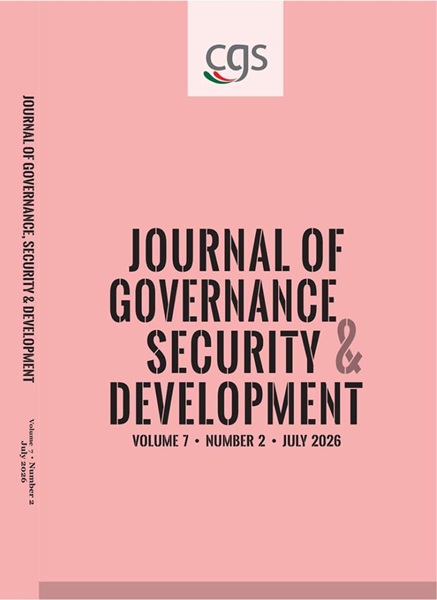
Volume 7 | Number 2 | Online Early Version
Online Version: ISSN No: 2708-2490
Print Version: ISSN No: 2709-0590
Price: BDT: 750.00, USD: 25.00
Publish Date: 15, March 2026
Article:
Sutapa Das
Abstract
The 2025 terrorist attack in Pahalgam, Kashmir, killed 26 civilians, raising India-Pakistan military tensions. In the days that followed, the US quickly engaged both sides diplomatically. The truce made Washington the crisis mediator. This article tests that claim. Did US crisis diplomacy advance strategic goals? Was it meant to demonstrate its importance and global dominance? This perspective documents historical events to address these questions. It contrasts diplomatic statements with media coverage. From there, it splits. Strategic diplomacy requires leverage, crisis management, and power, which are essential for negotiating favorable outcomes and maintaining international relations during conflicts. In contrast, symbolic diplomacy establishes credibility and communicates with multiple audiences. This pattern is clear from realist mediation and great-power context. Risk, notably nuclear escalation, alliance management in South Asia, and competitiveness with China motivated U.S. strategies, which generally emphasized regional stability and conflict prevention. The public story differed. Peace and temperance helped Washington appear steady and generous. The gap matters. Great powers are frequently interested, despite neutrality. Instead of competing, symbolic mediation and strategic calculation encouraged each other, allowing great countries to collaborate on global challenges. This confuses crisis management and global leadership.
Introduction
India and Pakistan have never really settled into peace. Since partition in 1947, they've fought four wars, bumped up against nuclear confrontation more than once, and spent decades trading accusations over Kashmir without either diplomacy or force ever resolving anything. Cross-border terrorism keeps pouring fuel on the fire—attacks traced to Pakistan-based militant groups have a reliable way of pushing both countries back to the edge.
Pahalgam fits that grim pattern. On 22 April 2025, gunmen killed 26 civilians in what Indian authorities attributed to Lashkar-e-Taiba and its affiliate, the Resistance Front. India didn't wait long. By 7 May, it had launched Operation Sindoor by striking on nine alleged militant sites inside Pakistan and Pakistan-administered Kashmir. Pakistan responded with drone incursions into Indian airspace. For several days, two nuclear-armed states were edging toward something neither of them could walk back from.
A ceasefire on 10 May stopped it. Then the arguing started over who deserves credit for that. Donald Trump was quick to claim it. He posted on Truth Social that the agreement came after "a long night of talks mediated by the United States." India's External Affairs Minister S. Jaishankar told a different story: the ceasefire, he said, was the product of direct military-to-military contact between the two sides, not American mediation. That's not a minor discrepancy. When the United States president and an Indian cabinet minister offer flatly contradictory accounts of the same event, something more than spin is going on. That gap is what this article is about.
The question at its center is blunt: was United States involvement in the post-Pahalgam crisis actually strategic, or was most of its performance? Strategic diplomacy, as used here, means action aimed at real outcomes—dialing down nuclear risk, holding alliances together, keeping the regional balance from tipping somewhere dangerous. Symbolic diplomacy means something different: it's about image. Claiming credit. Signaling that Washington still leads. Cementing the idea that global crises do not get resolved without American involvement. These two things are not mutually exclusive; they coexist all the time in great-power behavior. The challenge is pulling them apart by looking at what actually happened: who held leverage, who drove the narrative, and who rushed to own the outcome.
This article moves through four sections. The first places the argument in the broader literature on international mediation, realist theory, and United States policy in South Asia, while drawing out the distinction between strategic and symbolic action more precisely. The second explains the method—a qualitative case study built on process tracing and close reading of official statements, with honest acknowledgment of what public evidence can and cannot tell us. The third reconstructs the crisis itself, applying a realist lens to United States behavior and examining where hard strategic interests and image management ran together. The fourth draws the implications outward for reading this case, and for understanding how great powers handle future crises where controlling the conflict and controlling the story tend to become the same project.
Literature Review
To make sense of what the United States was actually doing during the Pahalgam crisis, this study pulls from three bodies of work: research on mediation as a tool of state interest, scholarship on United States foreign policy in South Asia, and realist accounts of how great powers use diplomacy, not just to settle disputes, but to manage perceptions. Together, they provide a way to distinguish between what states do to change outcomes and what they do to change how they look.
Mediation as an Instrument of Interest
The mediation literature doesn't flatter the idea of neutral third parties. Zartman and Touval's (1985) classic study of United States and British involvement in the Rhodesia–Zimbabwe negotiations laid it out plainly: states step in because they have something at stake. Peace is not the point; peace is the vehicle. What mediators are really after is an outcome shaped on terms they can live with, or better yet, benefit from.
Later work got more specific about mechanics. Bercovitch and Gartner (2006) identified leverage as the thing that actually makes mediation work—the capacity to reward cooperation or make non-cooperation costly. Countries with deep economic, military, or political ties to the parties in a conflict can apply that pressure; countries without those ties largely cannot. The problem is that the same embeddedness that gives leverage also makes it harder to be seen as a neutral actor.
Zhomartkyzy's (2023) more recent comparative work draws that tension out further. Surveying cases from Russia's role in India–Pakistan de-escalation to the ongoing deadlock in the Israeli–Palestinian conflict, she identifies three conditions that effective mediation typically requires: trust, perceived neutrality, and institutional legitimacy. Great powers usually lack one or more of these qualities. When they succeed anyway, it is usually because their interests and de-escalation happen to point in the same direction, not because they have risen above politics.
The Pahalgam case sits in that same territory. Washington had clear reasons to want the crisis contained. What is less clear is whether it actually drove the outcome of the Pahalgam case or whether it attached itself to a process India and Pakistan largely managed themselves and then stepped forward to take the credit for the resolution of the crisis.
United States Foreign Policy and South Asia
The scholarship on United States policy in the region tends to support a realist reading. Tellis (2002) argued that Washington's consistent priority has been stability, not as a value in itself, but as a precondition for protecting broader strategic and economic interests. United States interventions in South Asian crises, on this account, are not really about resolving disputes. They are about keeping things from getting catastrophic enough to disrupt everything else.
Pant (2011) tracked how that logic shifted as the United States–India relationship deepened. With China's reach expanding across the Indo-Pacific, India has become genuinely central to American regional strategy. This presents a challenging balance to maintain. Washington wants to cultivate India as a strategic partner, but it also needs enough functional access to Pakistan for intelligence sharing, logistical cooperation, and limited counterterrorism work. A serious India–Pakistan war would damage both relationships simultaneously.
Comparative cases reinforce the point. Asadi and colleagues (2023) showed how Iran and Russia approached mediation in the Karabakh conflict in ways that quietly advanced their own regional positions, all while speaking the language of honest brokerage. The surface framing was about peace; the underlying logic was about power. United States behavior in South Asia has followed a recognizable version of that same pattern, where it publicly promotes stability and peace while simultaneously pursuing its strategic interests in the region.
Realism and the Symbolic Dimension of Diplomacy
Offensive realism supplies a broader framework. Mearsheimer (2001) posits that in a system where one can never fully trust the intentions of others, states actively strive to enhance their relative standing and influence their environment before external events compel them to act. Diplomacy is one of the instruments they use to do that. His writing on hegemonic rivalry makes the South Asia angle clearer (Mearsheimer, 2006). The United States, he argues, will push back against the emergence of peer competitors anywhere that matters strategically. South Asia qualifies on multiple counts—geography, economic weight, and its entanglement with the wider Indo-Pacific competition with China. From that vantage point, United States involvement in the Pahalgam ceasefire looks less like a spontaneous crisis response and more like a deliberate move to preserve influence and foreclose space for Beijing.
This study pushes that logic one step further by taking symbolism seriously as a strategic instrument. Realists have traditionally focused on material power—military capability and economic coercion—but states also compete over narrative and status. They frame events, claim credit for outcomes, and work tirelessly to appear indispensable. These are not decorative moves; they send signals about resolve, shape what other actors expect, and reinforce hierarchy over time. Symbolic diplomacy, in other words, is not separate from strategy; it is one of the ways strategies get done. By tracking how Washington described and publicized its role in the ceasefire, this study connects those symbolic moves to the deeper contest over position and influence they were always serving.
Methodology
Research Design
This study uses a qualitative single-case design focused on United States diplomacy during the April–May 2025 India–Pakistan crisis—from the Pahalgam attack to the ceasefire on 10 May. The aim is not to count events but to make sense of them: what United States actions meant, how they were framed, and what they reveal about underlying intent (Yin, 2018).
The question is interpretive by design. What do observable actions and public narratives tell us about the purpose of United States involvement? To answer it, the analysis combines process tracing with discourse analysis. Process tracing reconstructs the sequence of diplomatic moves and statements. It looks for credible links between United States preferences, its actions, and the outcomes it later claimed. Discourse analysis shifts the focus to language—how the United States, India, and Pakistan described the crisis, assigned roles, and claimed credit.
Used together, these approaches do more than describe events. They expose patterns. If United States behavior consistently reflects leverage, coordination, and outcome-shaping, it points toward strategic diplomacy. If it leans on narrative control, credit claiming, and audience signaling, the case for symbolic diplomacy strengthens, suggesting that the United States may prioritize shaping perceptions and influencing public opinion over direct negotiation tactics. In practice, the interest lies in how the two overlap.
Data Sources
The analysis draws on four types of sources:
- Official statements and press briefings from United States, Indian, and Pakistani officials, including President Trump, Secretary of State Rubio, National Security Advisor Waltz, and External Affairs Minister Jaishankar. These show how actors presented their roles and intentions in real time.
- Reports from major outlets such as Yadav (2025), Reuters (2025), Al Jazeera, Kleiderman (2025), The Economic Times (2025), and The Times of India (2025) capture the flow of events, elite signaling, and public framing as the crisis unfolded.
- Scholarly work on mediation, realism, and United States policy in South Asia that provides the concepts and comparative benchmarks used to interpret the case.
- Statements from international organizations, including the UN Secretary-General’s office, offer an external view of the ceasefire and of United States involvement (UN News, 2025).
Sources were selected on three grounds: relevance, reliability, and recency. Where accounts diverge, most clearly as to whether the United States mediated the ceasefire or merely supported bilateral channels, the disagreement is treated as evidence, not noise. Competing claims are placed side by side and analyzed as part of the problem.
This approach has limits. The record is public and therefore incomplete. Private diplomacy, back-channel exchanges, and classified assessments remain out of reach. Media coverage can also be partial or biased. To offset this, the study triangulates wherever possible: it cross-checks official statements against multiple outlets, compares national narratives, and reads current reporting against established scholarship. The result is not a definitive account of causation, but a set of probability-weighted inferences grounded in observable mechanisms.
Analytical Framework
The analysis turns on four realist concepts: national interest, balance of power, anarchy and crisis management, and strategic restraint. Each is tied to observable indicators. National interest appears in United States concern over nuclear escalation and regional stability. Balance of power shows up in how Washington manages China’s role while balancing ties with India and Pakistan, particularly in the context of trade agreements, military alliances, and diplomatic negotiations that aim to maintain regional stability. Anarchy and crisis management are visible in efforts to control escalation without a central authority, particularly in the context of U.S. diplomatic initiatives aimed at reducing tensions in regions affected by nuclear threats. Strategic restraint is reflected in how far and how carefully the United States involves itself in international conflicts, particularly in balancing its relationships with China, India, and Pakistan.
At the same time, realism is treated as a testable claim, not a given. Alternative explanations—domestic political incentives, reputational concerns, bureaucratic momentum—are considered where they fit the evidence. The goal is not to force the case into a single framework but to see which explanation does the most work.
Analysis: United States Involvement in the Pahalgam Ceasefire
Crisis Timeline and Disputed Origins
The sequence matters. The Pahalgam attack on 22 April 2025 set off a rapid escalation: India’s National Investigation Agency blamed Lashkar-e-Taiba (LeT) and The Resistance Front (TRF) for killing 26 civilians (Reuters, 2025). On 7 May, India launched Operation Sindoor to strike sites across the Line of Control. Pakistan responded with drone incursions across multiple sectors, from Jammu and Kashmir to Gujarat. Within days, two nuclear-armed states were edging toward open conflict.
The ceasefire on 10 May stopped the slide, but not the argument over how it happened, with various parties disputing the effectiveness of the negotiations and the role of external influences in reaching the agreement. Washington claimed a central role. President Trump described the outcome as the product of “a long night of talks mediated by the United States” (Clearly, 2025). New Delhi rejected that outright, insisting the deal came through direct military-to-military contact (The Economic Times, 2025).
What is not in dispute is that the United States was active. Secretary Rubio and National Security Advisor Waltz were in repeated contact with both sides in the days before the ceasefire (Times of India, 2025). The question is what those contacts did. Did they apply leverage and shape the outcome? Or did they run alongside a bilateral process and later become folded into a United States claim of ownership?
National Interest vs Nuclear Risk
Start with the obvious driver: nuclear risk. A war between India and Pakistan would not stay contained. It would kill on a large scale and destabilize the Indo-Pacific economically, politically, and militarily in ways that cut directly against United States interests (Mearsheimer, 2001).
That alone explains why Washington engaged quickly. Calls to both capitals fit a familiar pattern: reassure India, press Pakistan, and reduce the odds of miscalculation in a system with no referee. But intent is easier to establish than effect. The public record shows intensive contact, not coercion. There is no clear evidence of threats, inducements, or leverage of the kind Bercovitch and Gartner (2006) describe.
What we do see clearly is narrative. The public claim of mediation suggests that the United States projects control and demonstrates competence in crisis management and leadership under pressure. India’s rejection takes a different tack. It limits how far we can credit United States diplomacy as decisive, suggesting Washington’s role was permissive—helping conditions for de-escalation rather than determinative, which raises questions about the effectiveness of U.S. diplomatic strategies in influencing outcomes in international conflicts.
Balance of Power: China in the Background
The China factor sits just beneath the surface. South Asia matters not only in terms of its terms but also as part of wider Indo-Pacific competition (Mearsheimer, 2006; Das, 2025). China’s footprint through the Belt and Road Initiative and the China-Pakistan Economic Corridor has deepened its reach across the region, while its naval presence expands in the Indian Ocean.
A prolonged India–Pakistan conflict would serve Beijing. It would tie down Indian resources, strain United States–India cooperation and pull Pakistan further into China’s orbit. Washington had every reason to prevent that. Deescalation preserved room to maneuver on both sides: it protected the United States–India partnership while keeping Pakistan from drifting fully into China’s camp.
There are other factors in play. Trump’s public messaging had a domestic audience. Bureaucratic routines in Washington also push toward engagement in any crisis of this scale, particularly when national security interests are at stake and public opinion demands a response. But these are secondary. The alignment between US behavior and long-standing balance-of-power priorities is too strong to ignore.
Anarchy and Crisis Management
No external authority manages India–Pakistan crises. Both sides operate in an anarchic setting, relying on their own channels and, when useful, outside help they can deny, which complicates the resolution of their conflicts and often leads to prolonged tensions. India’s long-standing opposition to third-party mediation holds in public, but its willingness to engage with US officials behind the scenes suggests a more pragmatic calculation.
That is where US diplomacy fits. Not as an arbitrator, but as a facilitator. It can reassure, signal, and apply quiet pressure without forcing either side into visible concessions. This technique is consistent with mediation theory: third parties are most effective when they enable restraint rather than imposing solutions (Zartman &Touval, 1985; Zhomartkyzy, 2023).
The signals themselves matter. Calls from Rubio and Waltz conveyed urgency and attention but stopped short of public threats. That ambiguity is useful, as it lowers the temperature without raising the political cost of backing down.
The limits are clear. Public sources do not reveal what was said in private or whether the United States had real leverage. India’s insistence on a bilateral outcome may reflect reality—or a post-hoc effort to assert autonomy. The distinction is hard to prove with open data.
Strategic Restraint and Symbolic Credit
United States behavior shows restraint. Washington pushed for de-escalation but avoided deeper involvement, no attempt to reopen Kashmir negotiations, no coercive measures, and no long-term commitments. That is consistent with a strategy that seeks influence without entanglement (Tellis, 2002).
At the same time, the United States moved quickly to claim credit. Trump’s statement did more than describe events; it framed them. It signaled leadership at home and reinforced the idea of United States indispensability abroad, even as India publicly pushed back, suggesting that the U.S. was taking a proactive role in global affairs despite challenges from other nations.
This is where the two logics meet. The diplomacy itself was not empty. There was real engagement, but the public narrative stretched its significance, suggesting that while diplomatic efforts were made, they may not have been as impactful as portrayed in the media. Stabilizing the crisis and owning the story became part of the same move, as both were essential strategies to manage public perception while addressing the underlying geopolitical tensions.
Taken together, the evidence points in one direction. Strategic imperatives, above all nuclear risk and competition with China, drove United States engagement. Symbolic claims amplified this engagement and influenced its perception. The two did not compete; they worked in tandem. The only real constraint is the evidence itself: with access limited to public records, claims about decisive influence remain plausible, but not provable.
Conclusion
United States involvement in the post-Pahalgam ceasefire shows how strategy and symbolism operate together in great-power crisis diplomacy. The evidence drawn from process tracing and discourse analysis points first to interest, not altruism. Washington acted to reduce nuclear risk, manage the regional balance against China, and protect its position in South Asia. The language of mediation and peace came later and did different work, primarily by framing the U.S. involvement as a neutral facilitator rather than a direct participant in the conflict.
The strategic side is visible in how the United States behaved: active but restrained, engaged with both sides, and careful not to overcommit. This is crisis management designed to stabilize without entanglement. The symbolic side is visible in how it tells the story. Claims of a “long night of talks” and direct mediation foreground narrative ownership, even where clear evidence of decisive leverage is thin.
Realism explains most of this. It treats mediation as a tool of statecraft, not a neutral service. But stopping there misses something important. Symbolic moves—public claims, credit-taking, the projection of indispensability—are not cosmetic. They reinforce strategic aims by shaping how others see power and leadership. In this instance, performance and practice collaborated rather than conflicted.
Two caveats matter. First, the evidence is limited. Public statements cannot reveal what happened in private, and they cannot settle the dispute between United States claims and India’s insistence on a bilateral outcome. What this analysis identifies are plausible mechanisms, not definitive proof of causation. Second, other forces were in play. Domestic political incentives and bureaucratic routines likely shaped how the United States responded and how it presented that response, influencing public perception and policy decisions in ways that may not align with the core strategic logic. They complicate the picture but do not displace the core strategic logic.
The broader implication is straightforward. Realism travels well here—but it needs to account for narrative as a form of power. Great powers do not just manage crises; they also compete to define them. India’s resistance to United States mediation claims points to a shifting regional balance, where rising states push back against external framing even when they accept quiet assistance.
This framework should hold beyond this case, but with caution. Other crises—Kargil in 1999, the 2001–02 standoff, and Pulwama–Balakot in 2019—offer useful comparisons, as do more recent episodes of India–Pakistan de-escalation. Still, outcomes will vary with context. Access to declassified records—across United States, Indian, and Pakistani archives—would allow a more precise reconstruction of what happened in April–May 2025 and a clearer test of how far strategic leverage, as opposed to symbolic positioning, actually shaped the ceasefire.
References
Al Jazeera. (2025). India–Pakistan tensions: A brief history of conflict. Al Jazeera, 9 May. https://www.aljazeera.com
Asadi, A., Zolghadr, M., &Pabandi, S. F. J. (2023). A comparative analysis of mediation efforts by Iran and Russia in the Karabakh conflict. Center for Strategic Research, 14(37), 153–164.
Bercovitch, J., & Gartner, S. S. (2006). Is there method in the madness of mediation? Some lessons for mediators from quantitative studies of mediation. International Interactions, 32(4), 329–354.
Cleary, O-A. (2025). India and Pakistan cease-fire appears to hold despite accusations of violations. Time, 11 May. https://time.com/7284654/india-pakistan-ceasefire-trump-us-mediation-kashmir-conflict-strikes/
Das, S. (2025). Sino-Indian rivalry and geopolitics of the Indian Ocean. Third Concept, 39(460), 26–28.
Kleiderman, A. (2025). India and Pakistan ceasefire appears to hold despite accusations of violations. BBC, 11 May. https://time.com
Mearsheimer, J. J. (2001). The Tragedy of Great Power Politics. W. W. Norton & Company.
Mearsheimer, J. J. (2006). China's unpeaceful rise. Current History, 105(690), 160–162.
Pant, H. V. (2011). The US–India Nuclear Pact: Policy, Process, and Great Power Politics. Oxford University Press.
Reuters. (2025). India charges Pakistan-based militant groups, six men over Kashmir tourist attack. Reuters. https://www.reuters.com
Tellis, A. J. (2002). India's Emerging Nuclear Posture. RAND Corporation.
The Economic Times. (2025). Cessation of firing and military action negotiated directly between India, Pakistan: EAM Jaishankar. The Economic Times, 22 May. https://m.economictimes.com
Times of India. (2025). India, Pakistan agree to ceasefire: How US stepped in to defuse cross-border tensions. Times of India. https://timesofindia.indiatimes.com
UN News. (2025). Guterres welcomes India–Pakistan ceasefire agreement as 'positive step'. UN News, 10 May. https://news.un.org
Yadav, N. (2025). US urges India and Pakistan to defuse tensions after Kashmir killings. BBC, 1 May. https://www.bbc.com
Yin, R. K. (2018). Case Study Research and Applications: Design and Methods (6th ed.). Sage Publications.
Zartman, W. I., &Touval, S. (1985). International mediation: Conflict resolution and power politics. Journal of Social Issues, 41(2), 27–45.
Zhomartkyzy, M. (2023). The role of mediation in international conflict resolution. Law and Safety, 3(90), 169–178.