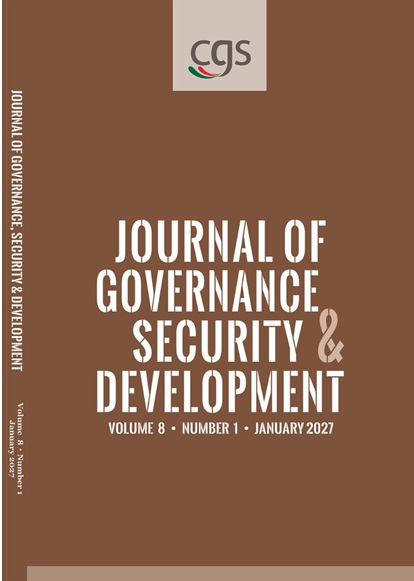
Journal Reference
Volume 8 | Number 1 | Online Early Version
Online Version: ISSN No: 2708-2490
Print Version: ISSN No: 2709-0590
Price: BDT: 750.00, USD: 25.00
Publish Date: 10, October 2026
Article:
A.R.M. Imtiyaz and Ramesh Ramasamy
Reference
Alesina, A., Devleeschauwer, A., Easterly, W., Kurlat, S., &Wacziarg, R. (2003). Fractionalization. Journal of Economic Growth, 8(2), 155–194. https://doi.org/10.1023/A:1024471506938
Amnesty International. (2022). Israel’s apartheid against Palestinians. https://www.amnesty.org/en/latest/campaigns/2022/02/israels-system-of-apartheid/
Amunugama, S. (1991). Buddhaputra and bhumiputra? Dilemmas of modern Sinhala Buddhist monks in relation to ethnic and political conflict. Religion, 21(2), 115–139. https://doi.org/10.1016/0048-721X(91)90059-Y
Anderson, B. (1983). Imagined communities: Reflections on the origin and spread of nationalism. Verso.
Aryasinha, R. (2001). Terrorism, the LTTE and the conflict in Sri Lanka. Conflict, Security & Development, 1(2), 25–50. https://doi.org/10.1080/14678800100590607
Asiwaju, A. I. (1984). Artificial boundaries. Lagos University Press.
Bar-Tal, D. (2007). Sociopsychological foundations of intractable conflicts. American Behavioral Scientist, 50(11), 1430–1453. https://doi.org/10.1177/0002764207302462
Bar-Tal, D., & Antebi, D. (1992). Siege mentality in Israel. International Journal of Intercultural Relations, 16(3), 251–275. https://doi.org/10.1016/0147-1767(92)90052-V
Bar-Tal, D., Halperin, E., & de Rivera, J. (2014). Collective emotions in conflict situations: Societal implications. Journal of Social Issues, 70(3), 476–492. https://doi.org/10.1111/josi.12071
Bhat, M. (2025). Majoritarianism. In C. Chan, M. Khosla, B. Liebman, & M. Tushnet (Eds.), The Oxford handbook of law and authoritarianism. Oxford University Press.
Bloxham, D. (2025). The 7 October atrocities and the annihilation of Gaza: Causes and responsibilities. Journal of Genocide Research, 1–26. https://doi.org/10.1080/14623528.2025.2483546
Brubaker, R. (1996). Nationalism reframed: Nationhood and the national question in the New Europe. Cambridge University Press.
Buzan, B., Wæver, O., & de Wilde, J. (1998). Security: A new framework for analysis. Lynne Rienner Publishers.
Ceylon Citizenship Act No. 18 of 1948. (1948). https://hrlibrary.umn.edu/research/srilanka/statutes/Citizenship_Act.pdf
Chatterjee, P. (1993). The nation and its fragments: Colonial and postcolonial histories. Princeton University Press.
Crossette, B. (2002). Sri Lanka: In the shadow of the Indian elephant. World Policy Journal, 19(1), 25–35.
Dassanayake, H. B., & Gamage, R. (2025). Horu versus boru: The politics of the 2025 local government elections in Sri Lanka. Polity, 13(1), 22.
Deegalle, M. (Ed.). (2006). Buddhism, conflict and violence in modern Sri Lanka. Routledge. https://doi.org/10.4324/9780203007365
De Silva, K. M. (1981). A history of Sri Lanka. University of California Press.
De Silva Wijeyeratne, R. (2013). Nation, constitutionalism and Buddhism in Sri Lanka. Routledge. https://doi.org/10.4324/9780203771631
DeVotta, N. (2004). Majoritarianism and Tamil separatism in Sri Lanka. In A. K. Sahoo (Ed.), Ethnic conflict and violence (pp. 23–45). Rawat Publications.
DeVotta, N. (2005). From ethnic outbidding to ethnic conflict: The institutional bases for Sri Lanka’s separatist war. Nations and Nationalism, 11(1), 141–159.
DeVotta, N. (2016). Engaging Sinhalese Buddhist majoritarianism and countering religious animus in Sri Lanka: Recommendations for the incoming U.S. administration. The Review of Faith & International Affairs, 14(2), 76–85. https://doi.org/10.1080/15570274.2016.1184440
DeVotta, N. (2020). Promoting covenantal pluralism amidst embedded majoritarianism in Sri Lanka. The Review of Faith & International Affairs, 18(4), 49–62. https://doi.org/10.1080/15570274.2020.1834980
DeVotta, N. (2021). Buddhist majoritarianism and ethnocracy in Sri Lanka. Sociological Bulletin, 70(4), 453–466. https://doi.org/10.1177/00380229211052143
Edrisinha, R., &Welikala, A. (Eds.). (2008). Power sharing in Sri Lanka: Constitutional and political documents, 1926–2008. Centre for Policy Alternatives.
Evans, J., Starr, J., Kelsey, C., Corichi, M., & Miner, W. (2023). Buddhism, Islam, and religious pluralism in South and Southeast Asia. Pew Research Center. https://www.pewresearch.org/religion/2023/09/12/buddhism-islam-and-religious-pluralism-in-south-and-southeast-asia/
Fearon, J. D. (1995). Rationalist explanations for war. International Organization, 49(3), 379–414. https://doi.org/10.1017/S0020818300033324
Fearon, J. D., &Laitin, D. D. (2003). Ethnicity, insurgency, and civil war. American Political Science Review, 97(1), 75–90. https://doi.org/10.1017/S0003055403000534
Fouz, M. Z. M., &Moniruzzaman, M. (2021). The Muslim minority-phobia in context: A critical study on majoritarian ideology and the structural roots of anti-Muslim phenomenon in post-war Sri Lanka. Journal of Muslim Minority Affairs, 41(4), 719–729. https://doi.org/10.1080/13602004.2022.2028462
Fraihat, I., & Hedaya, M. (2024). Understanding the October 7th Hamas attack on Israel and the war on Gaza. In G. Elkahlout (Ed.), Gaza’s cycle of destruction and rebuilding. Palgrave Macmillan. https://doi.org/10.1007/978-3-031-67198-2_5
Frosh, S. (2025). (In)security. The International Journal of Psychoanalysis, 106(1), 184–190. https://doi.org/10.1080/00207578.2025.2453290
Fuchs, A., &Navot, S. (2023). Nation-state law explainer. Israel Democracy Institute. https://en.idi.org.il/articles/24241
Gamage, R. (2021). Buddhist nationalism, authoritarian populism, and the Muslim other in Sri Lanka. Islamophobia Studies Journal, 6(2), 130–149. https://doi.org/10.13169/islastudj.6.2.0130
Gamage, R. (2023). Buddhist civilizational populism in Sri Lanka: Colonial identity formation, post-war othering, and present crises. Religions, 14(2), Article 278. https://doi.org/10.3390/rel14020278
Gawrych, G. W. (1996). The 1973 Arab-Israeli War: The albatross of decisive victory. Combat Studies Institute.
Ghanem, A. (2001). The Palestinian-Arab minority in Israel, 1948–2000: A political study. State University of New York Press.
Golani, M. (2010a). 1948: A history of the first Arab-Israeli war [Review of the book 1948: A history of the first Arab-Israeli war, by B. Morris]. Journal of Israeli History, 29(1), 125–129. https://doi.org/10.1080/13531041003595191
Golani, M. (2010b). Israel in search of a war: The Sinai campaign, 1955–1956. Sussex Academic Press.
Gordon, N. (2008). Israel’s occupation. University of California Press. https://doi.org/10.1525/9780520942363
Gross, J., & Tanter, R. (1980). Rational decision-making: Israel's security choices, 1967. Ohio State University Press.
Haniffa, F. (2019). Sri Lanka’s Muslims after the Easter Sunday bombings. South Asia Research.
Horowitz, D. L. (1993). The challenge of ethnic conflict: Democracy in divided societies. Journal of Democracy, 4(4), 18–38. https://doi.org/10.1353/jod.1993.0054
Imtiyaz, A. R. M. (2008). Ethnic conflict in Sri Lanka: The dilemma of building a unitary state. In M. Chatterji & B. M. Jain (Eds.), Conflict and peace in South Asia (pp. 131–153). Elsevier. https://doi.org/10.1016/S1572-8323(08)05009-1
Imtiyaz, A. R. M. (2015). The Sinhala-Buddhicization of the state and the rise of authoritarianism in Sri Lanka. World Affairs, 187(2), 201–212. https://doi.org/10.1002/waf2.12020
Imtiyaz, A. R. M. (2020). The Easter Sunday bombings and the crisis facing Sri Lanka’s Muslims. Journal of Asian and African Studies, 55(1), 3–16. https://doi.org/10.1177/0021909619868244
Imtiyaz, A. R. M. (2025). Sinhala-Buddhist nationalism, unitary state structure, and the JVP’s quest for power. Journal of Governance, Security & Development, 5(2). https://doi.org/10.52823/JIIO6929
Imtiyaz, A. R. M., & Mohamed-Saleem, A. (2015). Muslims in post-war Sri Lanka: Understanding Sinhala-Buddhist mobilization against them. Asian Ethnicity, 16(2), 186–202. https://doi.org/10.1080/14631369.2015.1003691
Imtiyaz, A. R. M., & Mohamed-Saleem, A. (2023). Some critical notes on Sri Lankan Muslim religious identity formation, conservatism, and violent extremism. Journal of Asian and African Studies, 58(3), 438–452. https://doi.org/10.1177/00219096211069651
Imtiyaz, A. R. M., & Mohamed-Saleem, A. (2025). Islamic faith as an ethnic identity marker: Overview of Sri Lanka Muslim identity formation, politicization, and violence. Journal of Asian and African Studies, 60(6), 3419–3432. https://doi.org/10.1177/00219096241230482
Imtiyaz, A. R. M., & Stavis, B. (2008). Ethno-political conflict in Sri Lanka. Journal of Third World Studies, 25(2), 135–152. [suspicious link removed]
Institute for Middle East Understanding. (2021, March 17). Fact sheet: Palestinian citizens of Israel. https://imeu.org/resources/palestine-101/fact-sheet-palestinian-citizens-of-israel/229
International Crisis Group. (2012). Sri Lanka’s north I: The denial of minority rights (Asia Report No. 219).
International Crisis Group. (2023). Israel and Palestine: Managing the crisis (Middle East Report No. 243).
Israel Ministry of Foreign Affairs. (2018). Basic Law: Israel as the nation-state of the Jewish people. https://mfa.gov.il/MFA/ForeignPolicy/Peace/Guide/Pages/Basic%20Law-%20Israel%20as%20the%20Nation-State%20of%20the%20Jewish%20People.aspx
Jalal, A. (1995). Democracy and authoritarianism in South Asia: A comparative and historical perspective. Cambridge University Press.
Jamal, A. (2007). Nationalizing states and the constitution of “hollow citizenship”: Israel and its Palestinian citizens. Ethnopolitics, 6(4), 471–493.
Jayawardana, K. P. (1997). Vijaya Kumaratunga assassination report. Pravada. https://polity.lk/wp-content/uploads/2024/09/Pravada-5.6-Vijay-Kumaratunga-assassination-report.pdf
Kaufmann, E., &Haklai, O. (2008). Dominant ethnicity: From minority to majority. Nations and Nationalism, 14(4), 743–767. https://doi.org/10.1111/j.1469-8129.2008.00362.x
Khalidi, R. (1997). Palestinian identity: The construction of modern national consciousness. Columbia University Press.
Khalidi, R. (2020). The hundred years’ war on Palestine. Henry Holt.
Kimmerling, B. (2001). The invention and decline of Israeliness: State, society, and the military. University of California Press.
Klem, B. (2011). Islam, politics and violence in Eastern Sri Lanka. The Journal of Asian Studies, 70(3), 730–753. https://doi.org/10.1017/S002191181100088X
Kodikara, S. U. (1989). The continuing crisis in Sri Lanka: The JVP, the Indian troops, and Tamil politics. Asian Survey, 29(7), 716–724.
Koopmans, R., & Orgad, L. (2022). Majority–minority constellations: Toward a group-differentiated approach. In L. Orgad & R. Koopmans (Eds.), Majorities, minorities, and the future of nationhood (pp. 1–34). Cambridge University Press.
Kydd, A., & Walter, B. F. (2002). Sabotaging the peace: The politics of extremist violence. International Organization, 56(2), 263–296. https://doi.org/10.1162/002081802320005487
Lake, D. A., & Rothchild, D. (1996). Containing fear: The origins and management of ethnic conflict. International Security, 21(2), 41–75. https://doi.org/10.2307/2539070
Litvak, M. (1998). The Islamization of the Palestinian-Israeli conflict: The case of Hamas. Middle Eastern Studies, 34(1), 148–163. https://doi.org/10.1080/00263209808701214
Lustick, I. (1988). For the land and the Lord: Jewish fundamentalism in Israel. Council on Foreign Relations Press.
Macris, J. R. (2016). Investigating the ties between Muhammed ibn Abd al-Wahhab, early Wahhabism, and ISIS. The Journal of the Middle East and Africa, 7(3), 239–255. https://doi.org/10.1080/21520844.2016.1227929
Morris, B. (2004). The birth of the Palestinian refugee problem revisited. Cambridge University Press.
Morris, B. (2008). 1948: A history of the first Arab-Israeli war. Yale University Press.
Morrison, C. (2020). Buddhist extremism, anti-Muslim violence and civil war legacies in Sri Lanka. Asian Ethnicity, 21(1), 137–159. https://doi.org/10.1080/14631369.2019.1610937
Oren, M. B. (2002). Six days of war: June 1967 and the making of the modern Middle East. Oxford University Press.
Pappé, I. (2006). The ethnic cleansing of Palestine. Oneworld Publications.
Peebles, P. (1990). Colonization and ethnic conflict in the dry zone of Sri Lanka. The Journal of Asian Studies, 49(1), 30–55. https://doi.org/10.2307/2058432
Peleg, I. (2000). Democratizing the hegemonic state: Political transformation in Israel. Cambridge University Press.
Peleg, I. (2020). Introduction to Israel dialectics—The 2018 Basic Law: Israel as the Nation-State of the Jewish People. Israel Studies, 25(3), 132–134. https://doi.org/10.2979/israelstudies.25.3.11
Peleg, I., & Waxman, D. (2011). Israel’s Palestinians: The conflict within. Cambridge University Press.
Pettigrew, T. F. (2003). Peoples under threat: Americans, Arabs, and Israelis. Peace and Conflict: Journal of Peace Psychology, 9(1), 69–90. https://doi.org/10.1207/S15327949PAC0901_03
Pfaffenberger, B. (1988). Sri Lanka in 1987: Indian intervention and resurgence of the JVP. Asian Survey, 28(2), 137–147.
Pushparajah, N., & Balamayuran, M. (2024). The failure of constitution-making in Sri Lanka (2015–2019). Millennial Asia, 15(1), 89–106. https://doi.org/10.1177/09763996221087017
Radzyner, A. (2010). A constitution for Israel: The design of the Leo Kohn proposal, 1948. Israel Studies, 15(1), 1–24. https://doi.org/10.2979/isr.2010.15.1.1
Rajapaksa, G. (2013). Sri Lanka’s national security. PRISM: A Journal of the Center for Complex Operations, 4(4), 139–155.
Ramasamy, R. (2023). Youth radicalization and violent extremism: A study of pathways in the post-war context of Sri Lanka. Journal of Youth Studies, 26(2), 229–249.
Rao, P. V. (1988). Ethnic conflict in Sri Lanka: India’s role and perception. Asian Survey, 28(4), 419–436.
Roberts, M. (1978). Ethnic conflict in Sri Lanka and Sinhalese perspectives: Barriers to accommodation. Modern Asian Studies, 12(3), 353–376. https://doi.org/10.1017/S0026749X00006193
Rouhana, N. N., & Sabbagh-Khoury, A. (2019). Memory and the return of history in a settler-colonial context: The case of the Palestinians in Israel. Interventions, 21(4), 527–550.
Said, E. W. (1979). The question of Palestine. Times Books.
Satkunanathan, A. (2020). Sri Lanka: Minority rights within shrinking civic space. In South Asia state of minorities report (pp. 196–229).
Shahid, R., & Lee, R. (2024). Saffron ethnocracy: Conceptualising ethnocracy in India, Myanmar, and Sri Lanka. Journal of Ethnic and Migration Studies, 50(19), 4924–4942. https://doi.org/10.1080/1369183X.2024.2376419
Shamir, J., &Shikaki, K. (2002). Determinants of reconciliation and compromise among Israelis and Palestinians. Journal of Peace Research, 39(2), 185–202. https://doi.org/10.1177/0022343302039002003
Shastri, A. (1999). Estate Tamils, the Ceylon Citizenship Act of 1948 and Sri Lankan politics. Contemporary South Asia, 8(1), 65–86. https://doi.org/10.1080/09584939908719856
Smith, A. D. (1998). Nationalism and modernism: A critical survey of recent theories of nations and nationalism. Routledge.
Smith, C. D. (2016). Palestine and the Arab-Israeli conflict (7th ed.). Bedford/St. Martin’s.
Smooha, S. (1997). Ethnic democracy: Israel as an archetype. Israel Studies, 2(2), 198–241.
Stepan, A. (2015). India, Sri Lanka, and the majoritarian danger. Journal of Democracy, 26(1), 128–140. https://doi.org/10.1353/jod.2015.0006
Subedi, D. (2022). Religion, extremism and Buddhist–Muslim relations in Sri Lanka. In I. Ahmed, Z. S. Ahmed, H. Brasted, & S. Akbarzadeh (Eds.), Religion, extremism and violence in South Asia. Palgrave Macmillan. https://doi.org/10.1007/978-981-16-6847-0_3
Supreme Court of Sri Lanka. (2023). Fundamental rights applications concerning the Easter Sunday attacks: SC/FR/163/2019 et al. [Judgment, January 12, 2023]. https://www.supremecourt.lk/wp-content/uploads/judgements/sc_fr_163_2019.pdf
Tambiah, S. J. (1992). Buddhism betrayed? Religion, politics, and violence in Sri Lanka. University of Chicago Press.
Tamil Guardian. (2024). “Strongly opposed to Indo-Lanka accord,” confirms JVP. https://www.tamilguardian.com/content/strongly-opposed-indo-lanka-accord-confirms-jvp
The Times of Israel. (2023). Hamas says purpose of massacres was a “permanent” state of war on Israel’s borders. https://www.timesofisrael.com/hamas-says-it-staged-massacres-to-cause-permanent-state-of-war-on-israels-borders/
The Times of Israel. (2024). Israel’s population ticks toward 10 million milestone as it marks 76 years. https://www.timesofisrael.com/israels-population-ticks-toward-10-million-milestone-as-it-marks-76-years/
Uyangoda, J. (2001). Beyond negotiations: Towards transformative peace in Sri Lanka. Marga Institute.
Uyangoda, J. (2005). Ethnic conflict, ethnic imagination and democratic alternatives for Sri Lanka. Futures, 37(9), 959–988. https://doi.org/10.1016/j.futures.2005.01.018
Uyangoda, J. (2010). Sri Lanka in 2009: From civil war to political uncertainty. Asian Survey, 50(1), 104–111. https://doi.org/10.1525/as.2010.50.1.104
Uyangoda, J. (2012). Travails of state reform in the context of protracted civil war in Sri Lanka. In K. Stokke & J. Uyangoda (Eds.), Liberal peace in question: The Sri Lankan case (pp. 35–62). Zed Books.
Uyangoda, J. (2024). NPP in power: Possibilities for post-war reconciliation through civic nationalism. Midpoint.
Varshney, A. (2003). Nationalism, ethnic conflict, and rationality. Perspectives on Politics, 1(1), 85–99.
Weiberg-Salzmann, M. (2014). The radicalisation of Buddhism in the twentieth and twenty-first centuries: The Buddhist Sangha in Sri Lanka. Politics, Religion & Ideology, 15(2), 283–307. https://doi.org/10.1080/21567689.2014.899066
Wickramasinghe, N. (2006). Sri Lanka in the modern age: A history of contested identities. University of Hawai‘i Press.
Wilson, A. J. (2000). Sri Lankan Tamil nationalism: Its origins and development in the nineteenth and twentieth centuries. University of British Columbia Press.
Yiftachel, O. (2006). Ethnocracy: Land and identity politics in Israel/Palestine. University of Pennsylvania Press.
Zohar, E. (2015). The arming of non-state actors in the Gaza Strip and Sinai Peninsula. Australian Journal of International Affairs, 69(4), 438–461. https://doi.org/10.1080/10357718.2014.988206